
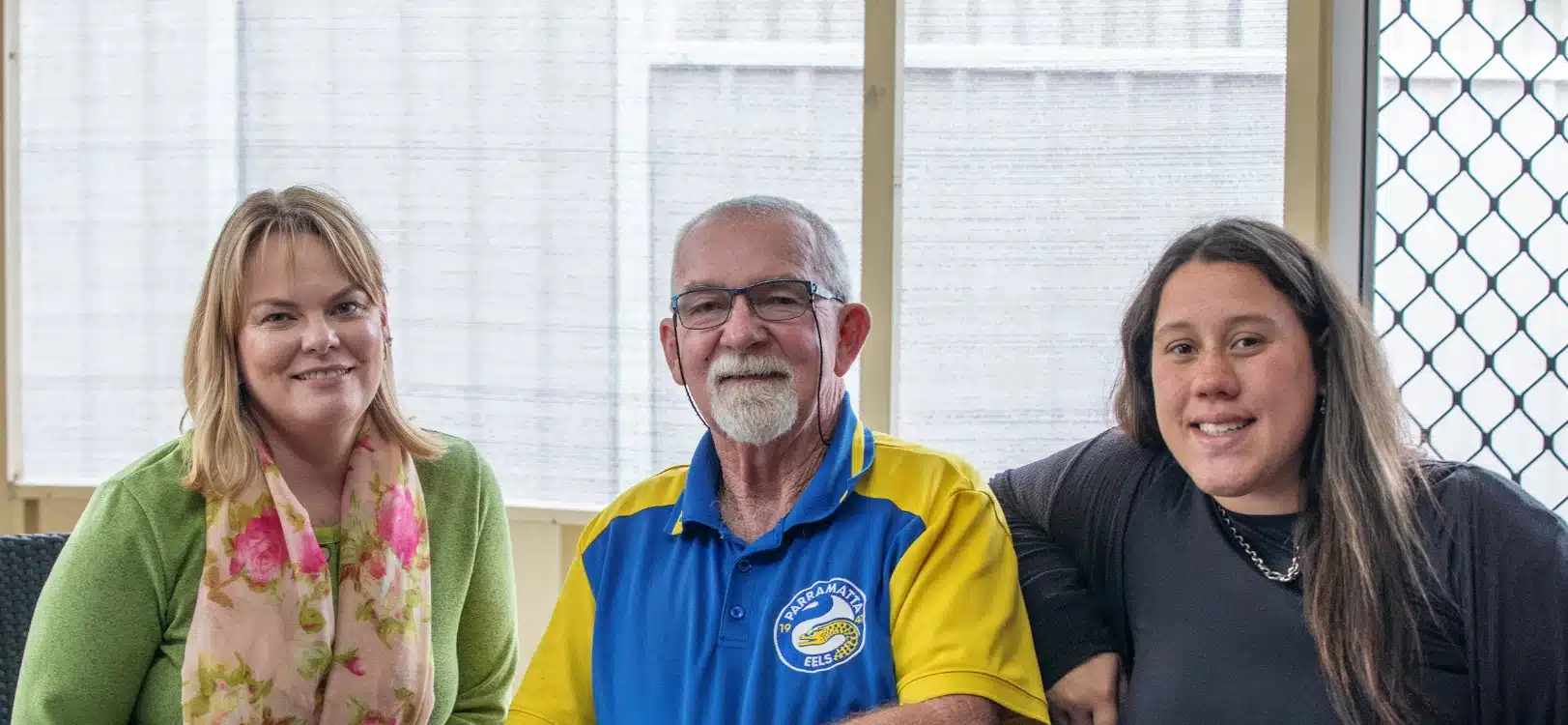
One morning in 2023, Lemon Tree Passage local John Rice woke up and knew something felt wrong.
“I couldn’t get out of bed. I had no energy,” he recalls. “I thought I must be coming down with something.”
John, who had recently lost his wife and was living alone, said it wasn’t until family checked in later that morning that they realised it was serious.
“I couldn’t move my right leg properly or my right arm,” John says. “Physically, apart from that, I was fine. Mentally I was fine, but I just couldn’t function.”
After being rushed to hospital, it would take weeks before doctors discovered the cause.
“I’d picked up a bug, like a Staph,” he said. “It affected my aortic valve and emboli travelled to my brain, gave me a couple little strokes.”
What followed was three and a half months in hospital and the start of a long road to recovery.
But John was determined to reclaim his independence and the life he loved. He took part in the Tailor and Connect research project, led by Professor Leeanne Carey from La Trobe University. There are three study sites involved, one in Melbourne, one in Adelaide and one here in Newcastle, being run by the Centre for Rehabilitation Innovation at the Hunter Medical Research Institute (HMRI) and the University of Newcastle.
The researchers are testing rehabilitation programs delivered in the home, that are tailored to each person’s needs and guided by new technologies that use artificial intelligence to improve how well stroke survivors recover their ability to complete everyday activities. They will also look at whether people feel doing the program improves their quality of life.
Tailor and Connect is designed for stroke survivors like John, who are living at home and are experiencing difficulties with their arm or hand function. It is tailored to each participant based on their capacity and recovery goals, which could be anything from basic tasks like using a phone or tying shoelaces, to more personal ambitions. With a lifelong passion for fishing, John made it his mission to return to his favourite hobby.
Over a 12-month period participants will be assessed face-to-face at certain intervals, but the therapy is delivered in the comfort of their own home. They will receive any equipment they may need (such as a laptop or tablet) and engage in two structured six-week bursts of therapy sessions, guided by a rehabilitation therapist online.
“A lot of the work was done at home with therapists talking to you on your computer or phone,” John says. “I call them my ‘tools of the trade’ and everything you needed to do the program was given to you.”
Researchers will measure recovery progress by analysing data collected by wristband sensors, which are watch-like devices worn by participants to monitor hand and arm use. Participants will also stay connected through an app which will check-in and ask them to answer a few basic questions about how they are feeling and managing at home.
Participants also have the option of being supported by a therapy buddy, often a family member or close friend who can attend the in-home sessions. For John, that therapy buddy was his granddaughter, Brittany.

“It’s good having another set of eyes,” John says. “By having a therapy buddy, they can pick up on little things.”
With personalised rehabilitation, a structured routine, and ongoing encouragement, John has made steady progress and can now tie off his own fishing lures again.
“I’m still doing rehab, still enjoying it, still living life the best I can,” he says. “You’ve got to take it in your stride but keep going forward.”
“I cook, clean, and mow my own lawn,” he says. “What used to take me 45 minutes might take two hours now, but I’ve got plenty of time.”
Though his recovery is ongoing, John remains optimistic.
“Tailor and Connect helps teach you how to train your mind,” he says. “Then you’re giving yourself the best chance and to me it’s all about making your life better.”
Louise Saxton
T: (02) 40420946
E: [email protected]
Lucy Bailey
T: (02) 4042 0570
E: [email protected]