Dr Caitlin Romanis is investigating genetic factors that may influence a child’s risk of developing acute lymphoblastic leukaemia (ALL).
The project analyses rare inherited genetic variants across the genome using data from thousands of children.
The findings could help researchers understand how genetics and environmental exposures may interact in childhood ALL.
September marks Childhood Cancer Awareness Month. It’s an opportunity to recognise children and families affected by cancer and the researchers working to understand its causes and improve outcomes.
This month, HMRI is shining a light on Dr Caitlin Romanis’ search for answers about one of the most devastating diseases to impact kids.
Dr Romanis, from HMRI’s Cancer Detection and Therapy Research Program and University of Newcastle, is investigating how environmental exposures and subtle genetic differences may work together to influence why some children develop acute lymphoblastic leukaemia (ALL).
“Childhood acute lymphoblastic leukaemia is the most prevalent childhood malignancy that we face both in Australia and worldwide,” Dr Romanis says.
ALL develops in the bone marrow, where immature white blood cells begin to develop abnormally.
“What we have is immature white blood cells that start to develop abnormally,” Dr Romanis explains. “Then we get this over proliferation where they start to crowd out healthy white blood cells, healthy red blood cells and platelets.“
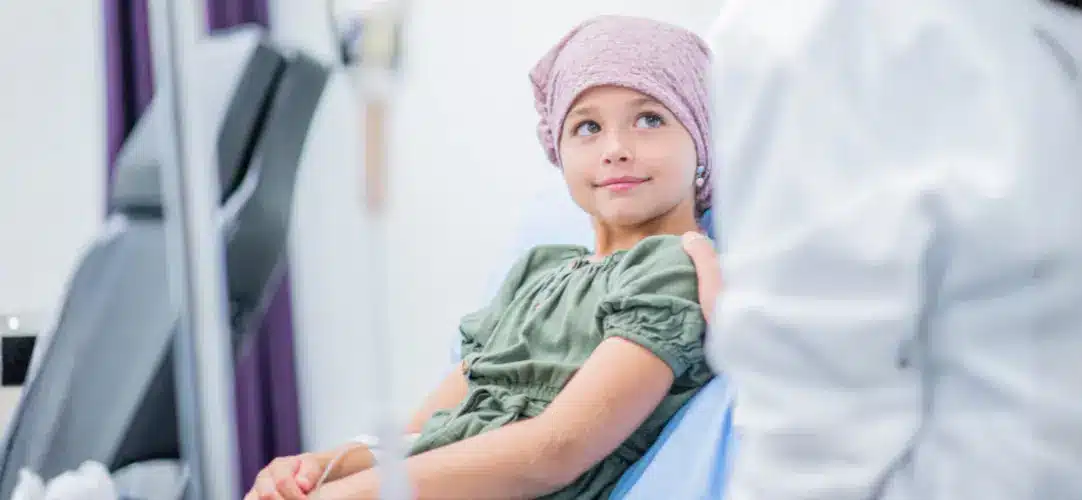
Thankfully, childhood ALL has a high cure rate, with more than 90 per cent of children going into remission.
While better treatment has transformed outcomes for children with ALL, an important question remains unanswered. Why does the disease develop in the first place?
Searching for inherited clues
“The research community has theories that it could be something that happens in two phases,” Dr Romanis says.
Some children may inherit genetic changes or mutations that affect their susceptibility to ALL. Other influences, including exposures before or after birth, may also play a role. Caitlin’s research explores how these factors might interact, without if any single exposure causes the disease.
Dr Romanis is tackling part of that question through a genome-wide analysis of rare germline variant burden in childhood acute lymphoblastic leukaemia.
The research project focuses on germline variants, meaning genetic differences that are present from birth and can be inherited from a child’s parents.
“When we’re talking about germline mutations or someone being born with a predisposition, that means they have a genetic difference that may increase their risk of developing ALL. They might have inherited it from a parent, or it may have arisen for the first time before birth. In addition to this predisposition, exposures around conception, during pregnancy or in early childhood may influence that risk”
Rather than looking for one single genetic change that causes ALL, Dr Romanis is investigating whether patterns of rare genetic variants could contribute to a child’s susceptibility.
“I’m specifically looking at the rare variants that occur from that germline stage,” Dr Romanis says. “They’re variants that we would expect to find in a really small number of the population.“
“Whenever I tell people what I do or that I’m technically a geneticist, they’re expecting me to look at long chains or long fragments of human DNA. But I’m looking at numbers and statistics more often than not.“
To do this Dr Romnis compares the genetic differences found in children with ALL with those found in children who don’t have the disease. If a particular difference appears more often in children with ALL, Dr Romanis uses statistical models to test whether it may be linked to their risk. This modelling includes looking at environmental exposures, because a child’s genetics and their environment may both play a part.
“Finding a link gives us a lead to investigate; it doesn’t prove that one genetic difference caused the cancer.”
Large datasets are particularly important for this work because childhood ALL is relatively uncommon.
“Because this is such a rare cancer, we need really large cohorts to be able to study anything with any real significance,” Dr Romanis says.
“What we do is pull children from different countries, different continents into one major research group so that we can go from studying something like 200 cases to 70,000.“
Genetics and the environment
While Dr Romanis’ current research is focused on inherited genetic variation, the ultimate goal is to understand how genetic susceptibility might interact with environmental exposures.
“There are some known risk factors for childhood ALL, such as benzene exposure, mum or dad smoking, pesticides.“
For people planning a pregnancy, Dr Romanis says reducing unnecessary exposure to potentially harmful chemicals is an important precaution.
However, most individual cases have no known cause, and exposure does not mean a child will develop ALL.
Dr Romanis hopes to understand how genetic differences and environmental exposures may work together to influence a child’s risk of developing ALL.
“If we can identify what genetically makes someone potentially more prone to being affected by a chemical, a toxin, or an environmental exposure, we can hopefully go about avoiding that exposure altogether and reduce the number of children diagnosed with ALL.”
Dr Romanis loves to work with children from the John Hunter Hospital and will often arrange for tours of HMRI so they can see how their local researchers are working hard to help them. Dr Romanis says the kids are inspiring.
“They’re just so excited to be here, they’re not afraid and they’re happy“
“It really helps me to come into work each day and still maintain that level of curiosity and passion.“
This Childhood Cancer Awareness Month, Dr Romanis’ research is helping to uncover another piece of the puzzle behind childhood ALL, with the hope that a better understanding of its origins will ultimately open new avenues for prevention, detection and treatment.
Tags
Dr Caitlin Romanis, hunter medical research institute